

A recent article by The Guardian in the UK has caught my attention. Titled, “’Bold, truth-telling’: learning from the rich histories of pan-African journalism” the report is very timely and even commendable. The report rightly noted that African liberation movements frequently employed print media as a powerful organising weapon. But there is one crucial omission: I.T.A. Wallace-Johnson of Sierra Leone (1894-1965). His contributions, particularly in the pre-World War II era in West Africa and beyond, deserves mention.
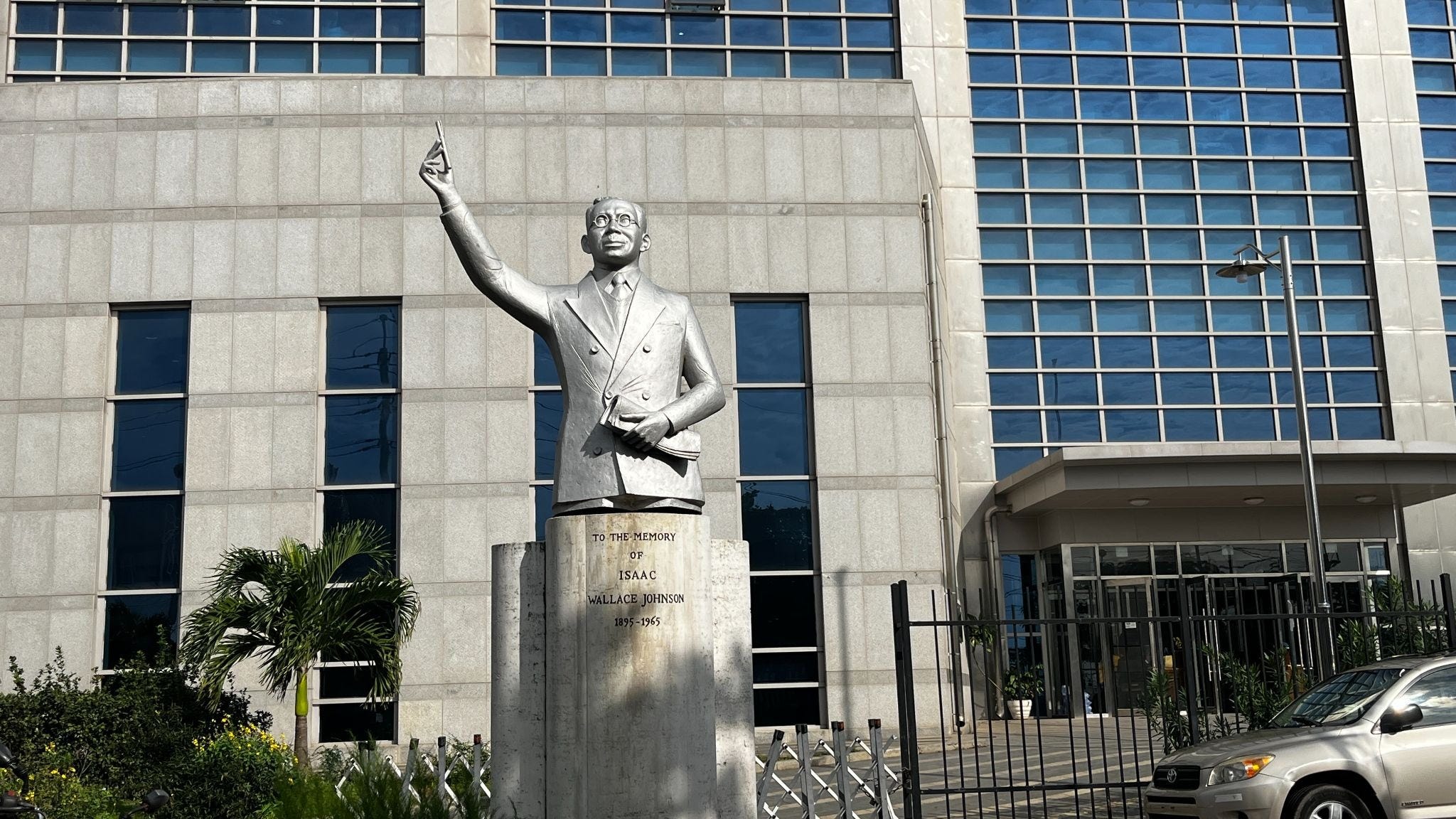
A Statue of I.T.A. Wallace-Johnson outside City Hall in Freetown, wielding his mighty pen. Photo credit: Eric Kawa.
In the 1930s, he served as editor of the anti-imperialist, anti-colonial and anti-capitalist newspapers: The Seafarer, a newspaper for black sailors and The Negro Worker. Crucially, alongside Nnamdi Azikiwe, who later became the first president of independent Nigeria, he co-edited the influential African Morning Post in Ghana around 1934. According to Historian Professor Ismail Rashid, Ghana’s independent leader, Kwame Nkrumah had noted that I.T.A. Wallace-Johnson’s writings influenced him as a young man.
But perhaps ITA’s (as he was fondly known) most vital contribution in this field was the establishment of the West African Youth League (WAYL), first in Ghana, and later in his native Sierra Leone. Here he combined grassroots anti-colonial organising with newspaper publication, The African Standard, established in 1939 in Freetown. As the first grassroots mass movement in West Africa, and with the help of its newspaper, it successfully backed candidates who won several local election seats. The African Standard (published in Sierra Leone) served as a powerful medium for spreading the Youth League’s message against colonial authority, imperialism, and capitalist exploitation. One of the major successes of I.T.A. Wallace-Johnson’s radical journalism is not just its anti-colonial organising, but directly forcing authorities to improve pay and working conditions of workers, especially those working in mining.
Professor Ismail Rashid who teaches History at Vassar College in the US and who has written extensively on I.T.A. Wallace-Johnson put it this way: “Mass media, especially newspapers, provided a vehicle for Africans and Black people to transmit information, further commercial, social and political interests, shape collective racial and national consciousness, and express views on colonialism and its impact on their lives.”
Rashid added: “By the 1930s and 1940s, they had become veritable instruments for articulating political grievances and furthering radical anticolonial, socialist and nationalist ideas in Africa. They became indispensable to burgeoning nationalist groups and movements in the continent.”
Not surprisingly, most of these radical newspapers were suppressed by the colonial authorities and in place, more conservative and compliant newspapers were allowed to flourish. In Ghana, laws were passed to suppress such radical publications that were becoming very popular in the colony. In 1934, a seditious libel law was proposed and the same playbook was employed by the colonial authorities in Sierra Leone in 1939 when ITA was arrested under World War II “Emergency” Laws and imprisoned throughout the duration of the war.
This tradition of radical journalism persisted in post-colonial Sierra Leone and the 1980s and 1990s through figures like Olu Awoonor-Gordon, an ardent pan-Africanist, who worked first with For Di People newspaper before founding the satirical Peep! magazine. These newspapers confronted the issues of their time, challenging dictatorship, exposing corruption, advocating for democracy and demanding accountability for human rights abuse.
So the question is, what is the current state of Black radical journalism in a period of renewed imperialism, heightened racism, and global geopolitical upheavals? The work of African based publications today that seek to amplify and continue this black radical tradition must be commended. In the era of the internet, online publications such as Pambazuka News, The Continent and Africa is a Country are welcome developments. But it is not enough.
Professor Rashid reminds us that the influence of the black radical press was crucial to spread ideas of freedom and liberation. Said Professor Rashid, “ITA Wallace Johnson and Nnamdi Azikiwe were trailblazers in the development of the radical West Africa Press in Ghana, Nigeria and Sierra Leone in the late 1930s. Wallace-Johnson was extremely skilled in utilizing the press to galvanize mass movements, in particular the Ethiopia Defense Committee and West African Youth League. He, undoubtedly influenced Kwame Nkrumah, who he worked with closely - along with George Padmore - during the 5th PAC and in the West African National Secretariat (WANS).”
Today, the press is no longer as influential, but young people of today have social media which they’ve deployed effectively in so-called Gen Z protests. Across Africa, from Senegal, to Nigeria, Ghana to Kenya and Morocco to Madagascar, the social media has replaced the black radical press of old in their struggle for social change in Africa.
To conclude, it is important to remind ourselves of what Steve Biko said: “The greatest weapon in the hands of the oppressor, is the mind of the oppressed.” This is still very much the case and one may be tempted to add that, the global corporate media is the primary “weapon of mind destruction” used to manufacture consent for an unjust global capitalist order that continues to perpetuate poverty and underdevelopment in Africa long after the end of slavery and colonialism.