
First published by Ticha Lemp Lemp Publication, Tuesday, 22nd September 2026.
A colleague, Karim Bah, recently published an op-ed proposing a two-year transitional government beginning in 2028, after which Sierra Leone would return to constitutional rule under a new social contract.
It is an ambitious proposition, and I think it deserves to be debated seriously rather than dismissed as political fantasy.
My difficulty begins with the transition itself. Who organises the transitional government and agrees its terms? Who selects the people who run it? Who supervises them? What happens to Parliament, political parties and the existing constitutional order? Would the current political establishment voluntarily hand over such an important process to an independent civic movement?
These questions do not necessarily invalidate Karim’s proposal. They actually expose the difficult mechanics of getting there.
His argument is attractive because it speaks to something many Sierra Leoneans feel, even if they express it differently. We have gone through elections, changes of government, constitutional reforms, commissions of Inquiry, development plans and endless political promises. We have changed the people occupying State House, changed parties in power and changed laws, but we keep returning to many of the same national frustrations.
That should tell us something that probably our problem is not how well we conduct the next elections. Maybe we need to examine the political structure within which every election takes place.
There is another reason Karim’s proposal is particularly interesting at this moment. Sierra Leone is already engaged in a constitutional conversation, although that process has become entangled in the politics and legal questions surrounding the current amendment process.
Parliament passed the Constitutional Amendment Bill on 10 August 2026, but the process has since been challenged over the constitutional voting threshold and other legal questions. The APC has taken the matter to the Supreme Court, while President Bio has also referred a related constitutional matter to the Court rather than immediately assenting to the legislation. The Supreme Court has scheduled the constitutional amendment matters for October 7.
Beyond those legalities lies the critical issue of the kind of political system we are trying to sustain or build.
The current constitutional debate includes important questions about elections and political representation. The proposed reforms include proportional representation, which the Government has argued would broaden participation in Parliament and create opportunities for women, young people and other groups. Those are important issues, but they cannot be the end of the conversation.
Do we continue changing electoral rules while leaving untouched the deeper architecture that makes winning the presidency such a consequential prize?
At this point, an old conversation came back to me. Several years ago, Dr. Omodele Jones, through his TINC movement, was making an argument that sounded radical at the time but deserves another hearing today. He was not proposing another presidential arrangement. Rather, he was questioning the arrangement itself.
His argument for a confederal system was built around the concern that too much of Sierra Leone’s political and economic life is concentrated at the centre.
When so much power and so many resources sit in Freetown, the presidency becomes an enormous prize. And when the presidency becomes an enormous prize, politics becomes a fight over who controls the centre.
Dr. Jones believed, and I subscribe to that view, that much of this power should move closer to the people and communities where the country’s resources are found and where development is supposed to happen.
His earlier work on confederalism envisaged stronger district-level economic capacity, including a development financing mechanism through which districts could pursue infrastructure and development projects.
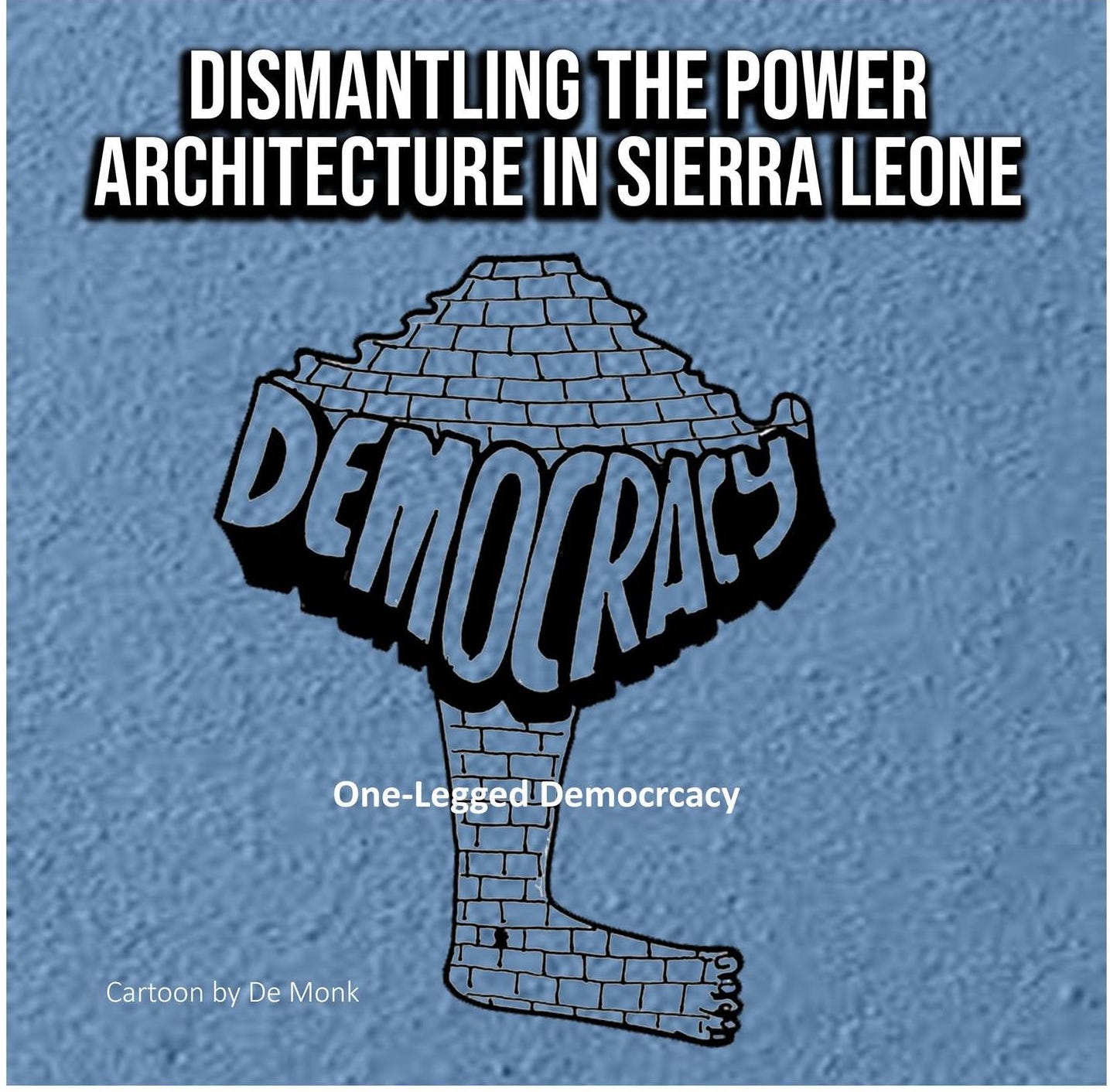
I remember that conversation because we may have spent too much time arguing about the occupants of the political house and too little time examining the house itself.
Karim is asking whether we need a two-year transition to negotiate a new social contract.
I am asking whether the reset should also include a conversation about where power actually lives.
If the presidency controls enormous political influence, access to national resources and the direction of the state, every presidential election will carry enormous stakes. Politics then becomes a struggle for control of the centre. The higher the stakes, the harder compromise becomes.
This may also explain something about our civic life. Karim’s historical references to 1977, the NPRC and AFRC reminded me of the very different environment in which civic mobilisation once took place. I would add another moment from our more recent history, the civic mobilisation around the march to Spur Road that helped turn public sentiment against Foday Sankoh and the RUF.
We may disagree profoundly about those periods and what they represented, but there was often a clearly identifiable common adversary around which people could organise. That environment has changed.
Today, there is an elected government and an opposition. There is SLPP and there is APC. There are people who identify strongly with one side or the other. There are also citizens who genuinely want to stand outside party politics.
Try to organise a major national civic movement around constitutional reform today and, before the first meeting is over, somebody will probably tell you who is behind it and what their motive is.
If the government dislikes it, it can be labelled opposition. If the opposition is suspicious about it, it can be labelled government propaganda. If neither side knows what to make of it, social media will probably decide for them.
That is one of the great difficulties of building civic solidarity in a deeply polarised democratic environment. It is also why I remain cautious about Karim’s transitional government proposal.
I can see the attraction of pressing the reset button. What I cannot yet see is the mechanism for getting Sierra Leone there without the reset itself becoming another political contest.
Suppose, somehow, Sierra Leone agrees to a two-year transition beginning in 2028. What happens after those two years?
If we return to precisely the same political architecture, with the same concentration of power at the centre, the same winner-takes-all incentives and the same rewards attached to controlling State House, we may simply be postponing the next confrontation. The calendar would have changed, but the architecture would not.
That is why I think Karim’s proposal opens a conversation that could be more important than the proposal itself.
It is not just about whether Sierra Leone needs a transition; it is about what we are transitioning to.
Once the Supreme Court has spoken and the current constitutional process is concluded, Sierra Leoneans will still have to live with whatever political system emerges. Will those changes alter the concentration of political and economic power that makes the presidency such a prized possession in the first place?
It is as if we have been looking at our political crisis from the wrong end. We focus on who should govern us instead of asking how much power any government should have in the first place. We keep debating which party should win instead of asking whether losing an election should really mean losing access to so much political and economic influence.
I think we should spend the period between now and 2028 deciding what we want 2028 to produce.
I do not know whether a two-year transitional government is the answer. Karim has made a case for it, and I think it deserves serious debate. My concern is that we may be trying to solve a structural problem with a political arrangement whose own structure has not yet been sufficiently explained.
Maybe Karim has started the right conversation with the wrong proposition.
The more important choice could be whether we move the 2028 election to 2030, or whether we use the period before 2028 to change what happens after every election. Moving the election date may only move the problem if we keep the same political architecture. If we change the architecture, 2028 itself could become the beginning of something different for the Moherland.
For me, the current political context gives us a unique opportunity to seriously engage in the conversation about who gets to exercise power, where that power should sit, and how our national wealth should be shared across the regions.
It should also be about whether the person or party that wins an election should inherit such enormous control over the political and economic life of the country.
Karim has opened a conversation that I believe we need to take further. The real task now is to use that conversation to decide what we want Sierra Leone to look like after 2028.
Ahmed Sahid Nasralla (De Monk) is the lmmediate past president of the Sierra Leone Association of Journalists (SLAJ).