

There is a thing the old people say when a person makes a promise and the wind carries it off before nightfall: Wɔd na mɔt, noto lod na ɛd. A word in the mouth is not a load on the head. It is folk wisdom with a tired smile behind it — the knowledge, earned over generations of watching, that talk costs nothing and a man or woman can set his or her words down the moment he or she turns from the crowd. The proverb does not scold. It simply warns you not to confuse the saying with the doing.
I want to take one word out of it.
Wɔd na mɔt, na lod na ɛd. A word in the mouth is a load on the head. You said it — now carry it.
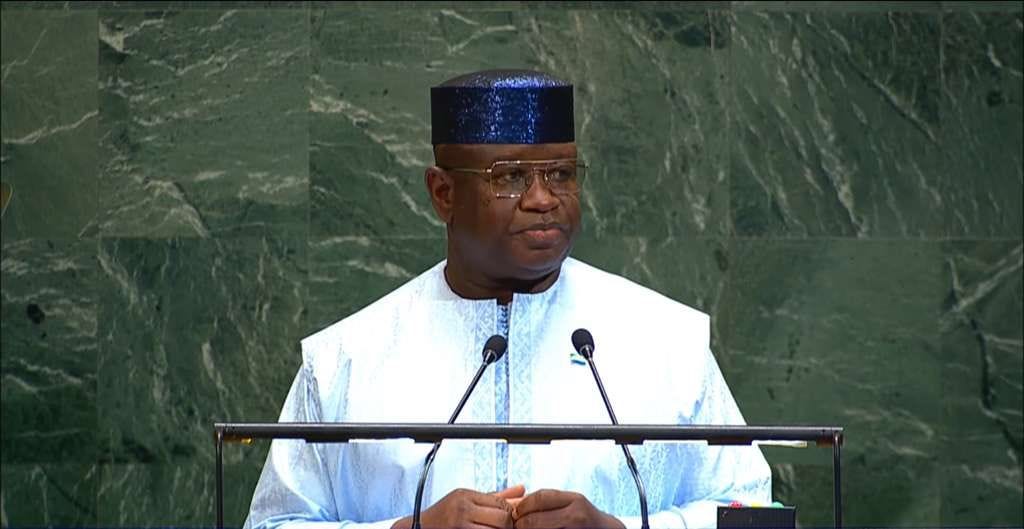
On October 12, in Geneva, President Julius Maada Bio made a word, and it was a good one. Speaking to the inaugural Geneva Peace Forum under the theme Choose Peace, he told the world’s leaders what any honest observer already knows: it is cheaper and wiser to prevent a conflict than to clean up after one. He named the things that rot a nation from the inside before any gun is fired — political exclusion, inequality, weak institutions, the slow leak of public trust. He called for credible elections, fair courts, real accountability, and dialogue that begins before grievance hardens into violence.
From the president of a country that buried its dead by the thousand in a war within living memory, it was not an empty word. It carried weight. Which is exactly the problem.
Because near the end of that same speech, Bio proposed something concrete. He suggested that governments and international bodies publish an annual account — the early warnings they received, and the actions they took in answer. Keep a ledger, in other words. Put the warnings and the responses side by side where the public can read them. Let the record speak.
It is a fine idea. So let us open the ledger here at home, where the president lives, and see what has been posted against the warnings this government has already received.
Start with the elections, since Bio did. In Geneva he called credible polls a foundation of peace. In June 2023, Sierra Leone held an election that remains the sharpest test of that very claim. The European Union’s observation mission, in its final report that October, set down serious failings in transparency and offered twenty-one reforms — among them the publication of results broken down to the polling station, cleaner tabulation, protection for candidates, and accountability for election-season violence.
Let me be plain about what that report was and was not. It was not a court overturning a result; no judge has unmade the declared outcome. It was a careful finding that the process had holes wide enough to warrant real repair. The distinction matters, because the legitimacy of a winner does not rest on the announcement alone. It rests on whether an ordinary citizen can trace, for herself, the road from her ballot to the final tally. In 2023, too much of that road was closed to her.
To its credit, the government did not simply shrug. A reform process followed, and the Tripartite Committee was born of it; some of its recommendations have since moved from paper toward practice, and that deserves acknowledgment. But a committee is a promise written down, and a promise written down is still a word in the mouth. The entry that belongs in the ledger is not we convened — it is we published the station-level results, we closed the gaps the mission named. That entry is not yet filled in.
Turn the page to the Constitution, where the ink is barely dry. On August 10, 2026, Parliament fell into open dispute over the Constitution of Sierra Leone (Amendment) Bill, 2025 — specifically, whether the proceedings needed only a simple majority under Section 91, or the two-thirds threshold that Section 108 demands of constitutional change. The opposition challenged the Speaker’s reading. The quarrel climbed, as such quarrels do, toward the Supreme Court.
And here the calendar does something I could not have arranged if I tried. On October 13 — the very morning after Geneva, while the applause had scarcely cooled — the Supreme Court resumed hearing three consolidated cases born of that disputed process. I will not tell you how the court should rule; that is its work, not mine, and the substantive questions are genuinely open. But understand what the two-thirds rule is. It is not decoration. It is a lock, placed deliberately on the nation’s founding document, so that no single season’s majority can remake the whole on a whim. A government that spends the morning of the 12th urging the world to guard its institutions, and faces a question about its own constitutional lock on the 13th, is being handed a mirror. The honourable thing is not merely to wait for the verdict. It is to be seen respecting the lock, and the court, while the question is live.
Now the heaviest entry, and I will not rush past it. In Geneva the president reached back to Sierra Leone’s own healing — the Truth and Reconciliation Commission, the Special Court — as proof that justice and reconciliation can hold hands. Then let that handshake reach everyone.
On August 10, 2022, protesters died. Bystanders died. Police officers died. The government stood up a Special Investigation Committee, but its work and the accountability that followed drew hard criticism. Amnesty International pressed for credible investigation into the deaths of civilians and of officers alike. The United States, in its own reporting, recorded concerns about how security forces conducted themselves and whether anyone answered for the blood.
None of that convicts the president, or any official, of anything; guilt is a matter for evidence, independent inquiry, and due process, and I claim no shortcut around them. But a people is entitled to a simpler accounting than a verdict. They are entitled to know that when the state’s own hand is in question, the state investigates with the same seriousness it brings when the accused is an opponent. Justice that checks a man’s party before it checks his wound is not justice; it is sorting. And a ledger with some deaths entered and others left blank is not a record of peace. It is a record of whose peace.
I could go further — dialogue that is counted in meetings convened rather than agreements kept is its own kind of empty entry — but the shape is clear enough now. Across every line, the pattern repeats: the word was made, and the load has not yet been carried.
I want to be careful here, because the easy version of this piece is alarmist, and alarmism is a lie of its own. Sierra Leone is not on the lip of another war. There is nothing in front of us that says so. But the absence of gunfire is not the presence of health. A country can be quiet while faith in its elections thins, while constitutional quarrels deepen, while ordinary people stop believing the referee is blind. Those are not the drums of war. They are the warnings Bio himself said a wise government should read early — and reading them at home is not something separate from the peacebuilding he preached abroad. It is the peacebuilding.
So I will take him at his own word, which is all a griot ever really does. He asked the world to keep a ledger of warnings received and actions taken. Let Freetown keep it first. Publish the honest accounting of the electoral reforms — done, pending, and whose hand is on each. Publish what became of the investigations into August 2022, within what due process allows. Show, in the current constitutional case, a plain respect for the court and the lock it guards.
None of this would cost the president his standing in Geneva. It would be the thing that earns it.
The old people are usually right, and their proverb is honest about men: the word is not a load on the head. Most words aren’t. They blow away. But the president stood on a world stage and chose peace out loud, and a word chosen that publicly, in front of that many witnesses, is heavier than the proverb allows. He made it a load. Now the only question Sierra Leoneans need ask is whether he will carry it home.
Wɔd na mɔt. Na lod na ɛd.
About the Author
J. Amadu Massally is a Sierra Leonean author, independent researcher, and cultural historian whose work connects African and diasporic histories through documentary evidence and historical inquiry. He writes on governance, public accountability, and the enduring connections between Africa and its diaspora.
Publication sources
The article is grounded in the following sources:
Geneva Peace Forum, October 12 keynote programme
EU Election Observation Mission, Final report and 21 recommendations
Supreme Court constitutional proceedings, October 13, 2026
Institute for Legal Research and Advocacy for Justice, Analysis of constitutional voting requirements
Amnesty International, August 2022 accountability concerns