

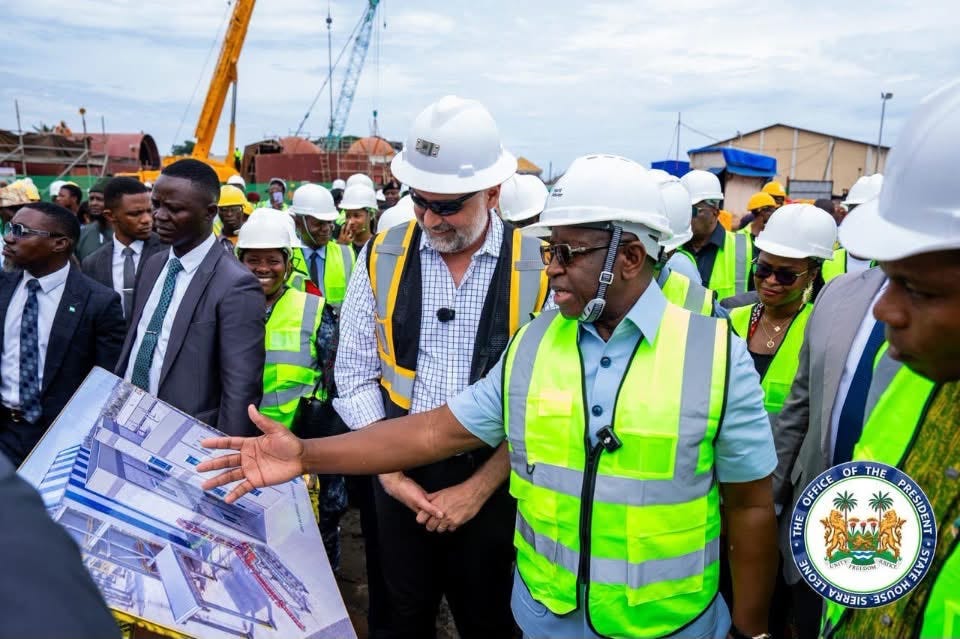
On 16 October 2026, President Julius Maada Bio inspected the Nant Power Plant under construction at Kissy Dock Yard. State House presented the visit as evidence of Sierra Leone’s approaching electricity transformation: a US$417 million, 108.4-megawatt gas-fired plant expected to begin generating electricity in September 2027.
The project is real. The investment is substantial. If completed and integrated successfully into the national grid, it could make a major contribution to Sierra Leone’s generating capacity.
But an inspection photograph is not a project history, and a project-cost headline is not a financing explanation.
The People’s Court therefore asks four questions:
Who originated the project? Who brought it to construction? Where did the US$417 million come from? And what obligations will Sierra Leone carry under the 22-year power-purchase agreement?
This inquiry does not begin with an allegation of corruption. No evidence presently before the Court establishes corruption in the Nant project. The purpose is narrower and more important: to separate achievement from appropriation, financing from government spending, and promised generating capacity from the price the public may eventually pay.
The first finding: Nant did not begin in 2024
State House says construction was officially launched in mid-2024. That is true as a statement about the present construction phase. It is not the beginning of the project.
The documentary history reaches considerably further back.
The project’s environmental assessment records that Blue Flare signed foundational agreements with the Government of Sierra Leone in July 2011. TCQ Power entered into arrangements with Blue Flare’s founders in 2012, followed by a joint-development agreement with CEC Africa in April 2013.
On 14 May 2014, under the administration of President Ernest Bai Koroma, the Government of Sierra Leone, the National Power Authority and the project companies signed the original power-purchase agreement. Parliament ratified it later that month.
The plant then existed in a different form. It was initially conceived as a heavy-fuel-oil project, with different capacities, sponsors and financing arrangements. The World Bank subsequently considered guarantees and financing for a 57-megawatt first phase, with possible expansion to 128 megawatts.
The project did not proceed according to that design. Sponsors changed. The World Bank withdrew. The proposed fuel changed from heavy fuel oil to gas. Capacity changed. Financing changed. The project survived by being repeatedly restructured.
Under President Bio, another major stage occurred. A revised project agreement was signed in November 2021. In October 2023, Parliament ratified an amendment describing a 148.5-megawatt Western Area Power Generation Project, with an initial phase of approximately 103 megawatts. The redesigned project moved toward liquefied petroleum gas and liquefied natural gas, a new financing package and a 22-year concession.
Groundbreaking followed in 2024, and the project reached financial close on 15 November 2024.
The present administration therefore deserves meaningful credit. It helped a long-delayed and repeatedly redesigned project reach financial close and physical construction. That is not a small accomplishment.
But advancement is not origination.
Even TCQ Power’s chief executive, Karim Nasser, described financial close as the culmination of a “12-year journey.” TCQ states that it initiated development in 2013 and remained lead developer through financial close.
A government may legitimately celebrate the milestone achieved during its tenure. It may not compress a twelve-year institutional history into a two-year political photograph.
The second finding: US$417 million is project financing, not government spending
The State House headline calls Nant a US$417 million project. That figure is supportable, but its composition matters.
The financing is reported as follows:
US$292 million in senior debt from the United States International Development Finance Corporation;
US$40 million in debt from the ECOWAS Bank for Investment and Development; and
US$85 million in equity from TCQ Power and Anergi.
The total is US$417 million.
That does not mean the Bio administration spent US$417 million on the plant. It means the private project company secured a combination of development-finance debt and sponsor equity.
The available financing announcements do not identify the Government of Sierra Leone as an equity investor. The government’s role is nevertheless substantial. It has supported the project politically and institutionally, participated in negotiating the agreements, and joined EDSA in the contractual structure under which the plant will sell electricity.
That distinction must be preserved.
Development-bank loans are not grants. Private equity is not public expenditure. Political-risk insurance is not construction money. And a government-supported independent power project is not the same thing as a government-owned power station.
There is another figure that has previously caused confusion. At the 2024 groundbreaking, officials referred to a US$412 million DFC package. That consisted of up to US$292 million in lending and as much as US$120 million in political-risk insurance. It was not the plant’s total construction cost and should not be added to the present US$417 million figure as though both amounts were separate investments in concrete, turbines and pipes.
The current US$417 million calculation is straightforward: US$332 million in debt plus US$85 million in sponsor equity.
The public celebration is warranted. The public explanation should be equally clear.
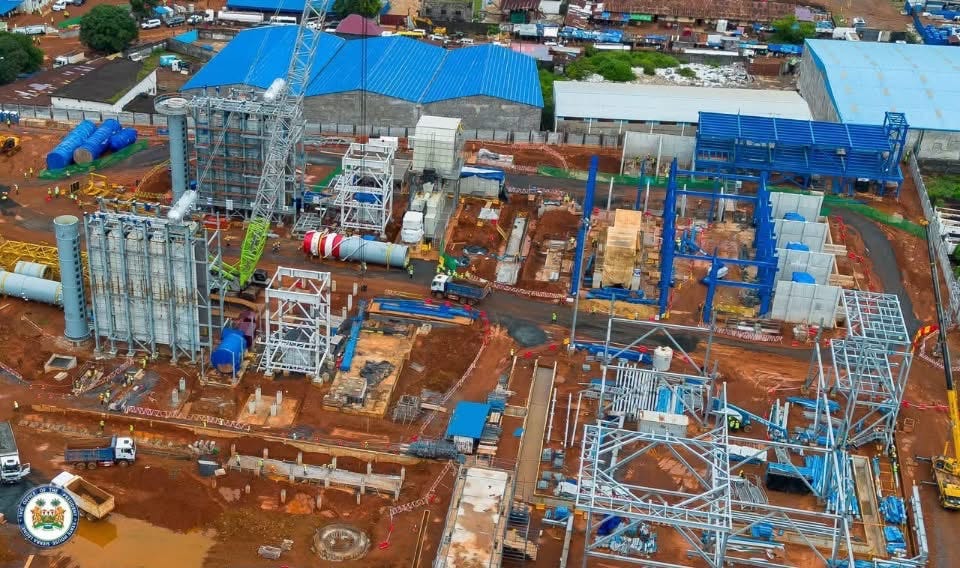
The third finding: 108.4 MW and 105 MW can both be accurate—but 148.5 MW requires explanation
State House now describes the plant as having a capacity of 108.4 megawatts. DFC and the project sponsors generally describe it as a 105-megawatt plant.
Those figures are not necessarily contradictory. Technical project documents identify approximately 108.4 megawatts as gross output. The lower 105-megawatt figure may represent rated, net or commercially deliverable capacity after the plant’s internal consumption. The available documents, however, do not expressly reconcile the two figures.
The larger unresolved question concerns the 148.5-megawatt figure.
Parliament’s official record shows that on 19 October 2023 it ratified the “148.5 MW PPA Amendment for the Western Area Power Generation Project.” Government presentations at the time described an initial phase of approximately 103 megawatts, suggesting that 148.5 megawatts may have represented the contemplated full project rather than the first plant to be built.
The government should now explain the relationship among these figures:
148.5 MW in the PPA amendment ratified by Parliament;
approximately 105 MW in the financing documents; and
108.4 MW gross in current technical and State House descriptions.
Has the project merely proceeded with its first phase? Was the PPA subsequently amended again? Does the 22-year agreement cover the current plant alone or later expansion? Are capacity payments calculated against installed, available or contracted capacity?
There may be entirely reasonable answers. The public should not have to assemble them from separate press releases.
The fourth finding: generation is not the same as affordable electricity
A 105-megawatt power plant can substantially increase Sierra Leone’s generating capacity. It cannot, by itself, resolve every weakness in the electricity system.
The electricity must be transmitted through a grid capable of carrying it. EDSA must be able to purchase it. Technical and commercial losses must be controlled. Customers must be metered and billed. Revenue must be collected. Fuel must be imported reliably. Foreign-exchange exposure must be managed. The final tariff must be affordable enough for households and businesses while remaining sufficient to keep the system operating.
The project will initially depend on LPG delivered to the site, with the ability to use LNG. The public therefore needs to know who bears changes in international fuel prices, shipping costs and exchange rates.
An earlier version of the project used a two-part tariff: a capacity charge covering capital and fixed operating costs, and an output charge under which fuel costs passed through to the purchaser. That earlier contractual structure cannot automatically be assumed to govern the redesigned Nant project. The current 22-year PPA must speak for itself.
Parliament was told in 2023 that the revised tariff was competitive and among the lowest regional tariffs for gas generation. But the published parliamentary proceedings reviewed for this inquiry do not disclose the actual tariff.
“Affordable” is a conclusion. The tariff is the evidence.
The fifth finding: Sierra Leonean participation should be measured, not merely announced
State House reports that Sierra Leoneans undertook the construction work at the site. Local employment and skills transfer would be genuine public benefits.
But the statement is too broad without supporting figures.
The engineering, procurement and construction contractor is Shapoorji Pallonji, an international company. Siemens technology is central to the generating equipment, and Siemens Energy is expected to operate or support operation of the completed facility.
The government and developers should disclose:
the number and percentage of Sierra Leoneans employed;
the categories of work they perform;
the number occupying technical and supervisory positions;
the training and certification provided;
the proportion of procurement awarded to Sierra Leonean businesses; and
the permanent jobs expected after construction.
Local labour should not be reduced to a ceremonial sentence. If Sierra Leoneans are building the plant, let the employment record show it.
Questions the public is entitled to have answered
The People’s Court finds that the available public presentation is incomplete.
The Government of Sierra Leone and EDSA should publish or clearly summarize the material terms of the current 22-year PPA, subject only to narrowly justified commercial redactions.
The following questions require answers:
What electricity tariff has been agreed, and how will it change over the life of the agreement?
Is EDSA required to make capacity payments when it cannot take all available electricity?
What government guarantees, letters of credit or other payment-security arrangements support EDSA’s obligations?
Who bears LPG and LNG price increases?
In what currency are the current PPA obligations denominated, and who bears the resulting foreign-exchange risk?
How does the 148.5-megawatt PPA amendment relate to the 108.4-megawatt gross plant now under construction?
What transmission upgrades are required, who is financing them, and will they be completed before first power?
What is the verified percentage of construction completed as of October 2026?
How many Sierra Leoneans are employed, and in what positions?
What consumer tariff or public subsidy will be necessary for EDSA to purchase and distribute Nant’s electricity sustainably?
These are not opposition questions. They are ownership questions. Sierra Leoneans will live with the project long after the groundbreaking speeches, inspection tours and present officeholders have passed.
Judgment
The Court finds that the Nant project is a significant national undertaking with the potential to strengthen Sierra Leone’s electricity supply.
The Court credits TCQ Power and its successive partners with sustaining a project whose development stretches back more than a decade.
The Court credits the Koroma administration and the Parliament of 2014 with establishing important early contractual foundations.
The Court credits the Bio administration with renegotiating and advancing the redesigned project through parliamentary approval, development financing, financial close and active construction.
The Court does not award any administration exclusive ownership of the project.
The Court further finds that the US$417 million headline represents development-bank debt and private sponsor equity. It should not be presented or understood as US$417 million spent by the Government of Sierra Leone.
The unresolved public issue is disclosure.
Sierra Leone does not need another argument in which one political party claims the entire plant and another denies that any progress has occurred. Both positions would diminish the record.
The evidence supports a more mature conclusion: the project crossed administrations, survived redesigns and reached construction through the combined work of governments, developers, lenders, contractors and public institutions.
The turbines may belong to the project company. The political credit must be shared. The contractual consequences will belong to the people.
The Court therefore orders—not as a court of law, but in the name of public accountability—that the government place the material economic terms before the country.
Show the tariff.
Show the guarantees.
Reconcile the capacity figures.
Identify the public risks.
Count the Sierra Leonean jobs.
Then the people can judge not only how large the plant is, but what its electricity will truly cost.
The People’s Court
Verdict: Progress established. Exclusive political ownership rejected. No corruption alleged or found. Full contractual disclosure still required.
About The Author
Amadu Massally is a Sierra Leonean author, independent researcher, and cultural historian whose work connects African and diasporic histories through documentary evidence and historical inquiry. He writes on governance, public accountability, and the enduring connections between Africa and its diaspora.
Documentary Record
The findings in this article are based on the following official, lender and project-sponsor records. The State House release of 16 October 2026 was supplied in full by the State House Media and Communications Unit; the remaining records are publicly accessible at the links below.
State House Media and Communications Unit, “Sierra Leone’s President Julius Maada Bio Inspects US$417M Nant Power Project as Sierra Leone Targets 2027 Power Boost,” 16 October 2026.
Anergi, “Anergi Announces Financial Close of the Nant Project in Sierra Leone,” 13 December 2024.
U.S. International Development Finance Corporation, “The Nant Project Receives Its First Disbursement in Sierra Leone,” 10 December 2024.
U.S. International Development Finance Corporation, “DFC, Sierra Leone Promote Access to Reliable Energy With Up to $412 Million in Additional Financing and Political Risk Insurance,” 8 May 2024.
DFC-hosted Environmental and Social Impact Assessment for the CECA SL Generation Limited Project, Sierra Leone.
Copperbelt Energy Corporation, “CECA Sierra Leone.”
Parliament of Sierra Leone, Votes and Proceedings, 19 October 2023.
World Bank, Sierra Leone Western Area Power Generation Project, Project Appraisal Document, 2016.
National Investment Board of Sierra Leone, Technical Specification of Transmission Line Survey Works for the Nant Project.