

I recently saw a video on social media in which an SLPP party apparatchik floated the idea of holding elections in 2030, instead of 2028. He has since clarified his statement, but it actually got me thinking and I kind of agree with the delay of elections until 2030, except that my vision is fundamentally different from what the SLPP party leaders have in mind. I think such a delay must not entrench the political status quo, but seeks to reset the country under a new social contract between the citizens and future governments. But first, some context.
Stalemate, stagnation and retrogression
Sierra Leoneans are trapped in a stalemate, a cycle of permanent state of electioneering without development or progress. Despite nearly 30 years of ‘democracy’ and repeated elections, and 60 years of independence, we seem to be stuck politically, constitutionally and ‘developmentally’
Basic infrastructure and social services needed for the survival of citizens is either non-existent or a luxury affordable to only a few. In Freetown, access to potable water and continuous electricity is simply not there while the city itself has degenerated into a glorified slum city. The decaying houses, sprawling urban slums, and general chaos are palpable. Dead bodies are sometimes left unattended on main streets for days, a grim reflection of our systemic collapse.
Key state institutions such as electoral bodies, the judiciary, and police have been effectively captured by the current SLPP Government, even worse than what we saw under the Ernest Bai Koroma-led APC government.
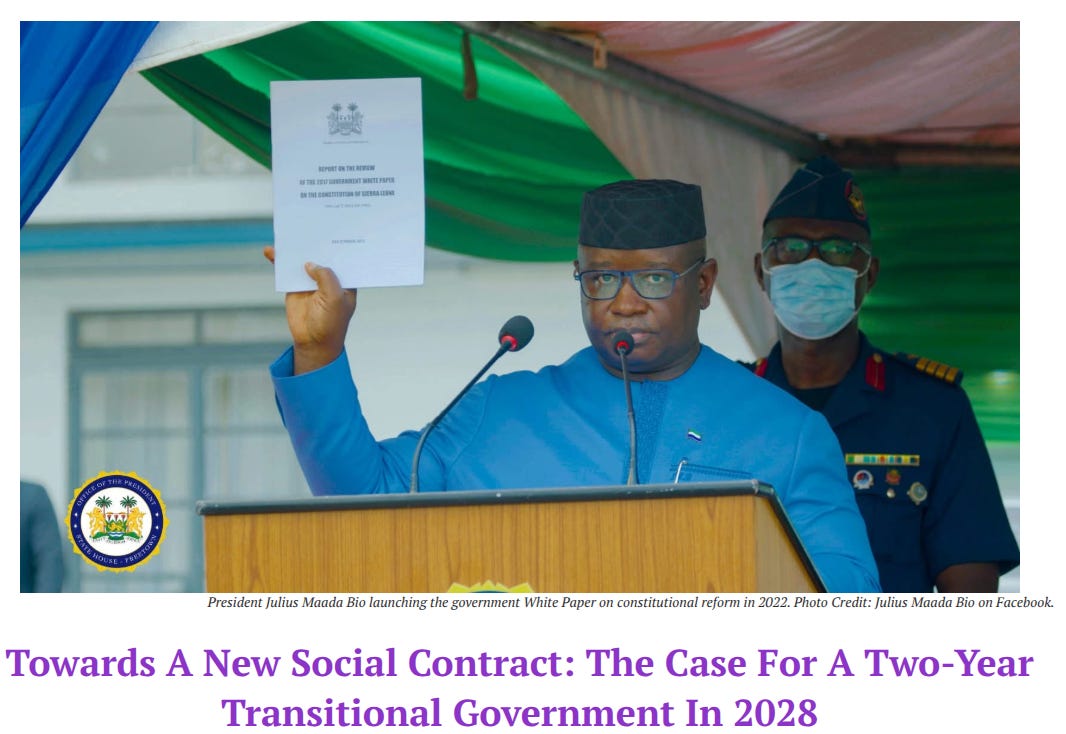
But even more worrying as a nation is the fact that the 1991 constitution, cobbled together under one party rule with little or no public consultations, is not fit for purpose but the process of trying to develop a new one has all but stalled for the past three decades. A democracy that seems unable to produce a constitution.
We all know the reason for this stalled constitutional reform process - incumbent governments have always sought to manipulate the outcome to their own political advantage. For example, the previous government simply abandoned a very expensive review process led by the late Justice Cowan after spending millions in consultations. The current SLPP government has resorted to a piecemeal approach focusing mainly on those areas that will help them retain power. We cannot continue like this. What is clear is that constitution-making cannot take place effectively under the stewardship of a sitting government that is actively competing to retain power. When the players are in charge of making the rules, you can only guess the outcome.
A Two-year Transitional Government
With that said, I will return to my argument for a 2030 vote. To achieve a new social contract grounded in a constitution fit for purpose, independent electoral bodies, an impartial judiciary and public officials that are accountable to citizens and not the president, the best way forward is a two-year transition framework with a Constituent Assembly and an Interim Government.
Such a transition Government should have a clearly defined mandate. Firstly, to draft a new constitution that is citizen-led and that clearly addressed some burning issues like resource management and governance.
The second task would be to conduct a credible census to establish accurate demographic data that is free from political manipulation. Not the contested ones we’ve seen in recent times. A third, but equally important task in the mandate would be to overhaul the elections management bodies, especially the Electoral Commission for Sierra Leone to ensure absolute independence and organise free and fair elections and handover power.
Think of the Constituent Assembly as an upgraded and more impactful Bintumani 1 and 2 Conferences but with representatives directly elected or selected by communities as well as representatives from civil society. Political parties will be excluded from the Assembly which will elect an interim President who will form a government in collaboration with civil society and citizens association. However, political parties can submit proposals for consideration by the Assembly.
To ensure that the Constituent Assembly members and new Interim Transition Government members do not manipulate the constitutional process to favour them, all members of the Transitional Government and Constituent Assembly (CA) must be constitutionally barred from seeking elected office or any political appointments in a future Govt. This mechanism ensures that governance is entrusted to credible, career professionals, academics, lawyers, and civic leaders including grassroots people like market traders, whose sole incentive is national service.
The Choice Before Us
I know that some might argue that this is far-fetched and unrealistic. Some might question the process and feasibility of setting up an independent transitional government. In my view, we as a people have a choice to make - a continuation down the path that leads to perpetual stagnation, or a radical reset and experiment that ensures a peaceful, progressive and stable future.
This transitional arrangement would build on a proud tradition of civic resistance that started with the 1977 students uprising through to the pro-democracy Bintumani 1 and 2 Conferences, to the anti-NPRC women led marches and the August 18 1997 anti-AFRC protests. Such a democratic revolution will also set the stage for future struggles for economic emancipation of the working people of Sierra Leone.
As Frederick Douglass once said: “Power concedes nothing without a demand. It never did and it never will.” Therefore, it is entirely up to us to demand change or it will never happen. Instead of waiting for a saviour, we need to think and act collectively for the Sierra Leone we wish to see. For me, I’m just putting ideas out there, maybe some Gen Zs are listening. So yes, I agree with Mr. Moses Mambu. Let’s do 2030. But I am sure he will disagree with me completely. For once, let’s think outside of the box. It is insufficient and unhelpful to complain that our democracy doesn’t work without taking concrete steps to fix it besides the periodic, ceremonial elections that happen every five years.
This article was first published by Engage Salone an online publication.
https://www.engagesalone.org/